
Lift Ev'ry Voice and Sing
100 years ago, in February 1926, Dr. Carter G. Woodson founded Black History Week in the second week of February. He chose that week so it would coincide with the birthdays of Abraham Lincoln (02/12) and Frederick Douglass (02/14). Woodson's concept was later expanded into Black History Month, an annually observed, month-long celebration of African- American life, history, and culture.
In truth, Black history is and always has been an essential part of United States history. But because the culture, history, and achievements of African-Americans were often completely overlooked, omitted or distorted in USA history books and other places (and in some respects, continues to this day), Woodson felt the need to promote the achievements of his people.
Black History Month was officially recognized in the United States in 1976 by President Gerald R. Ford as a way of moving our country towards greater equality during the Bicentennial. Sadly, we still have a long way to go. Nevertheless, we do and must continue to celebrate the gifts that our Black siblings have brought to our nation and our denomination, the ELCA.
One of the hallmarks of African-American culture and history is its music. Whether jazz, blues, rock and roll or spirituals, music has sustained Black people in this country for centuries and still does so today. Indeed, music was a significant part of what supported the freedom fighters and protesters during the Civil Rights movement of the 1950’s and 1960’s. Songs like “We Shall Overcome”, “This Little Light of Mine “and “Ain’t Gonna Let Nobody Turn Me Round”, inspired and comforted legions of people who would work to make America a country where everyone, regardless of their race, creed, or culture, could live and thrive.
Artists and activists would gather to sing and share this music in homes, rallies, church meetings, and informal gatherings. Music both created and sustained communities working for civil rights and justice, just as it does today.
In the streets of Minneapolis, the music of resistance is being born anew. Songs are being written by people young and old, that tell the story of what’s happening in their beloved city. And whether people are gathered in large church buildings singing songs of freedom and hope, or standing on icy streets in front of hotels and other businesses, they are bearing witness to God’s call for justice even as they preach compassion and love through song. Music is upholding the people.
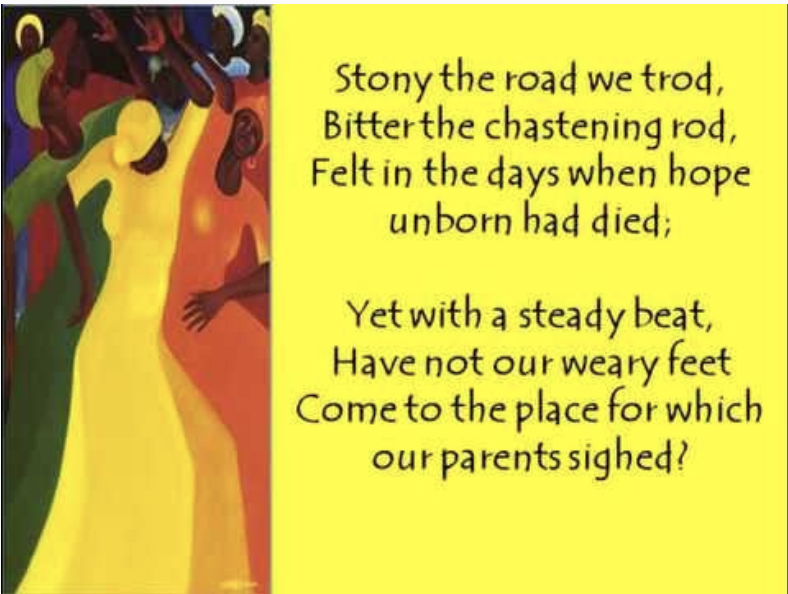
In a similar fashion, the hymn, “Lift Every Voice and Sing” (ELW 841) continues to uphold God’s people. Last year after having a long conversation about the hymn and how it should be sung, a dear friend of mine, Pastor Bradley Schmeling, who serves Gloria Dei Lutheran Church in St. Paul, MN, wrote these words: “Lift Every Voice and Sing” is considered to be the Black National Anthem, because it contains a history that must not be forgotten. The hymn, in both tune and text, names the ongoing wound and grief carried by those descended from enslaved people. Yet it begins with “Lift EVERY Voice and Sing.” This is not the wound of one particular people, “their” history, but the history of all who bear the wounds of white supremacy, including people of European ancestry. The racial divide in the United States, the acknowledged grief, and the societal structures that make supremacy invisible to many, hurt all of us. In a time when the government is systematically erasing the history of Black Americans from public view, singing this hymn, experiencing the poetry of James Weldon Johnson as truth, and recognizing the sacred role this hymn plays in African-American life is an act of prophetic resistance, repentance, and solidarity with every part of God’s beloved community. It should be sung intentionally, reverently, boldly, and at a pace that allows us to take in the deep experience that it represents.”
When we sing it together at Gloria Dei this Sunday, may it be so.
Login To Leave Comment